

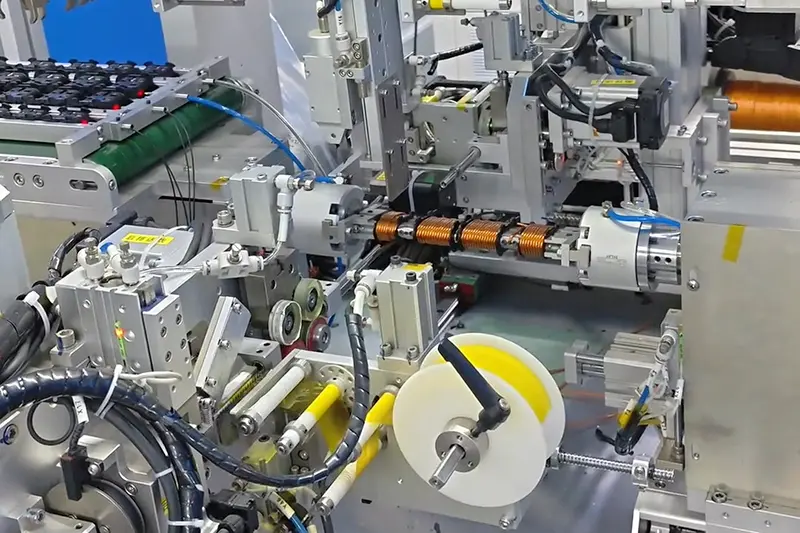
In the context of new energy vehicles (EVs), a “quad-channel on-board charger coil” typically refers to a multi-coil structure used in high-power, integrated magnetic technology (such as integrating multiple inductors or transformer coils onto a single magnetic core, or multiple coils in a four-channel interleaved parallel topology).
Due to the extremely high demands of new energy vehicles for high power density, high efficiency, lightweight construction, and harsh operating conditions (vibration, high and low temperatures), the design characteristics and fully automated winding processes of these coils differ significantly from those of ordinary industrial coils.
The following are the core features of quad-channel OBC coils and key considerations in the fully automated winding process:
1. Compact and Magnetic Integration Design
To save space and reduce weight within the vehicle, quad OBC coils typically employ magnetic integration technology.
• Features: Multiple windings (such as four inductor coils) share a single composite core. Space utilization between coils is extremely high, with a very compact arrangement—even to the point of interleaving.
• Impact: This places extremely high demands on spatial freedom during winding; even slight deviations in wire routing can cause interference between coils.
2. Use of Large-Cross-Section Flat Wire or Multi-Strand Litz Wire
To address the skin effect and proximity effect caused by high frequencies (typically 100 kHz–300 kHz or higher) and to handle high currents:
• Flat wire: High volume fraction (up to 70% or more) and good heat dissipation, but it is stiff and exhibits significant springback when bent.
• Multi-strand Litz wire: Consists of hundreds of fine insulated wires twisted together; it offers good flexibility but has a relatively large outer diameter. Additionally, the outer layer typically features a nylon or polyester braided sleeve, which is prone to wear.
3. High Insulation Rating and Withstand Voltage Requirements
OBCs operate on high-voltage platforms of 400 V or even 800 V, with high transient voltages.
• Characteristics: Coils typically use triple-insulated wire or enameled wire with extremely high temperature resistance (e.g., Class H, 180°C or higher).
• Impact: Absolute safety creepage distances must be maintained between coil layers, between turns, and between the coil and the core.
4. Rigorous Thermal Management and Vibration Resistance
Vehicles are subjected to high-frequency vibrations and temperature fluctuations (from -40°C to 120°C) during operation.
• Characteristics: After winding, the coils must exhibit highly consistent shapes and a tight structure with no looseness; they are typically encapsulated as a whole with thermally conductive silicone gel or epoxy resin.
About WIRESUN
Founded by a management team with over 30 years of hands-on expertise in coil winding, WIRESUN has grown into one of Dongguan's trusted precision coil manufacturers. We provide OEM and ODM custom coil winding services, producing air core coils, bobbin coils, and special-shaped coils, along with coil winding machines and wire tensioners.
Contact us:
tech@wiresun.com | +86-186 2185 7689 (Bi Danfeng)