

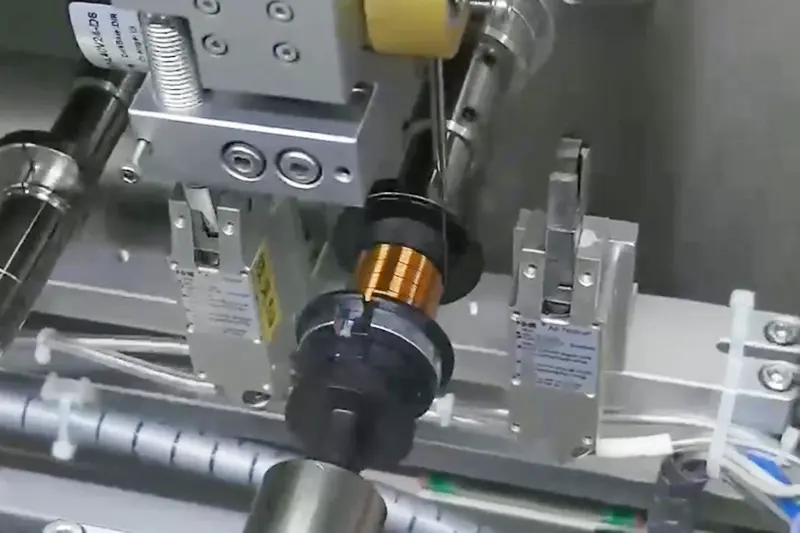
Transmission solenoid valves operate continuously in a harsh environment characterized by high temperatures, intense vibration, and immersion in automatic transmission fluid; therefore, the winding process for their coils must meet very strict requirements. The following are the key considerations for winding transmission solenoid valve coils:
OEM Manufacturing of Transmission Solenoid Coils | WIRESUN
1. Material Selection and Matching
• High-temperature-resistant enameled wire: Due to the high operating temperatures inside the transmission, high-temperature-rated enameled wire must be selected (typically Class H at 180°C or Class C at 200°C or higher, such as polyimide-coated enameled wire), and the enamel coating must possess extremely strong resistance to corrosion by automatic transmission fluid (ATF).
• Form material: The coil form should be made of engineering plastics that are heat-resistant, oil-resistant, and have high dimensional stability (such as PPS polyphenylene sulfide or glass-filled nylon) to prevent deformation at high temperatures, which could cause coil breakage or jamming.
2. Winding Process Control
• Precise Tension Control: Tension during the winding process must be uniform and moderate. Excessive tension stretches the copper wire, resulting in a thinner wire diameter, higher direct current resistance (DCR), and even damage to the insulating varnish coating; insufficient tension leads to loose wire arrangement, affecting slot fill rate and heat dissipation.
• Neat Winding: A precision flat-winding process should be used whenever possible. Neat winding not only maximizes slot fill rate to provide sufficient electromagnetic pull but also effectively prevents excessive voltage differences between adjacent conductors caused by “messy winding,” thereby reducing the risk of inter-turn short circuits.
• Strict Control of the Number of Turns: The number of turns directly determines the solenoid valve’s inductance and the resulting magnetic field strength. The number of turns must strictly match the design value; any deviation will directly affect the solenoid valve’s response speed and opening/closing pressure.
3. Lead Wire and Terminal Processing
• Reliable Connections: The connection between the ends of the enameled wire and the metal pins (terminals) is a highly failure-prone area. Spot welding, TIG welding, or special mechanical crimping are typically used. The welds must be secure and free of cold joints to withstand prolonged high-frequency vibrations while the vehicle is in motion.
• Stress Relief: An appropriate buffer length should be left in the lead wires before connecting them to the terminals to prevent physical tension caused by thermal expansion and contraction or vibrations from breaking the wire ends.
4. Insulation and Final Encapsulation
• Interlayer Insulation and Wrapping: For multi-layer windings, high-temperature-resistant insulating tape must be used for interlayer insulation when necessary. The outermost layer of the coil must be tightly wrapped to prevent the wires from coming loose.
• Injection Molding or Potting: Once winding is complete, the coil must not be left exposed; it must be fully encapsulated via injection molding or vacuum-potted using high-performance epoxy resin. This step is critical to completely isolate the coil from transmission fluid containing minute metal impurities, thereby preventing short circuits and electrical leakage.
5. Quality Inspection and Control
• Turn-to-turn withstand voltage test: This is a key test for identifying microscopic damage to the varnish coating or stress-induced damage to the windings, effectively screening for early-stage turn-to-turn micro-short circuits.
• Full Electrical Parameter Inspection: After winding, 100% testing of DC resistance (DCR) and inductance must be performed to ensure they fall within strict tolerance limits.
• High-Voltage Insulation Test: Tests the insulation resistance and dielectric strength between the coil and the core/housing to ensure there is no risk of electrical leakage.
About WIRESUN
Founded by a management team with over 30 years of hands-on expertise in coil winding, WIRESUN has grown into one of Dongguan's trusted precision coil manufacturers. We provide OEM and ODM custom coil winding services, producing air core coils, bobbin coils, and special-shaped coils, along with coil winding machines and wire tensioners.
Contact us:
tech@wiresun.com | +86-186 2185 7689 (Bi Danfeng)